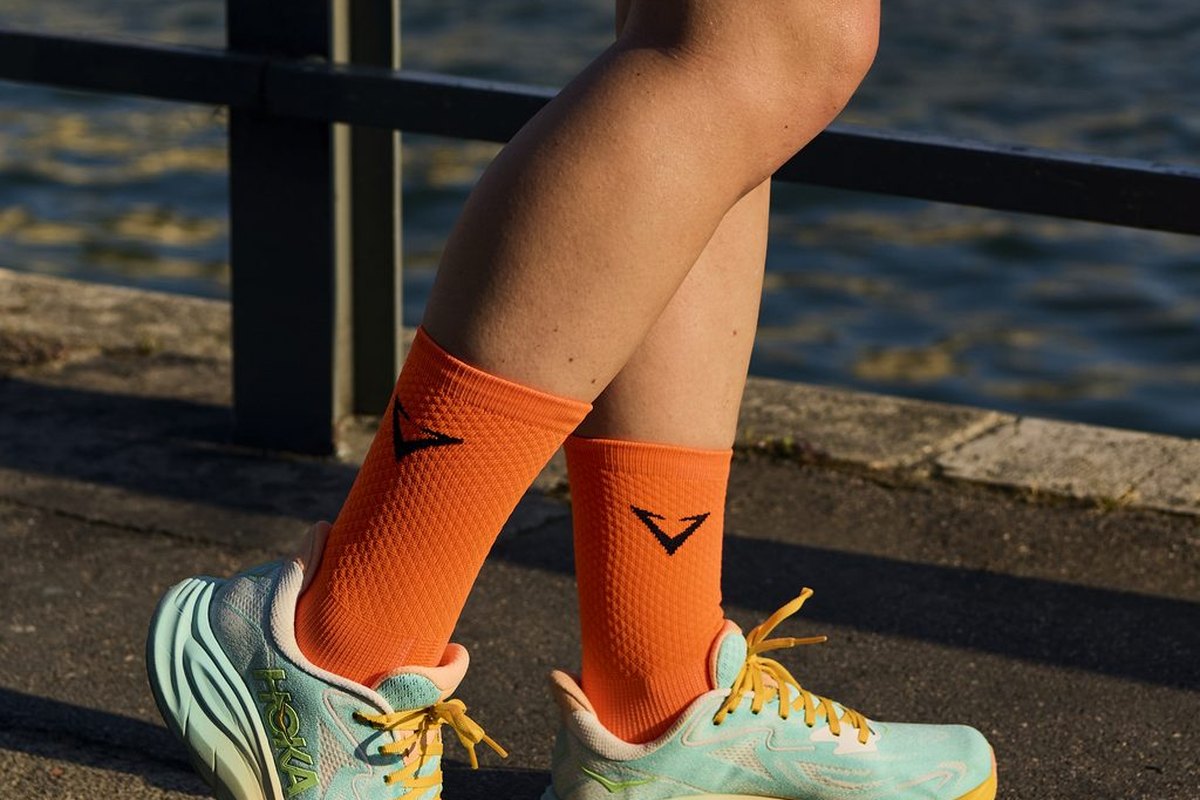
You start the session with socks at the ankle and finish with them bunched somewhere under your arch. It is annoying, it changes how the shoe feels, and it is usually fixable.
Why socks slip down
The cuff has given up. Elastic dies with heat and stretch. A sock that stayed up for a year will not stay up forever, and tumble drying speeds that along.
The heel pocket does not sit on your heel. Most no-show and ankle socks have a shaped heel. If the sock is too big, that pocket sits below your heel, and every step drags the cuff down with it.
Your shoe collar is doing the pulling. Low-cut trainers with a stiff collar catch the sock cuff on each stride. Common with lifting shoes and some court shoes.
Sweat. Wet fabric against wet skin slides. In Singapore this is most of the reason, most of the year. Cotton makes it worse because it stays wet.
Foot shape. High insteps and narrow heels give the cuff less to hold onto.
What actually works
1. Size down, or size properly. Sock sizing is vague, so people buy one size for everything. If the heel pocket does not land on your heel, nothing else you do will help. How to check your size.
2. Go a little taller. A crew or quarter height puts the cuff above the shoe collar so it stops getting dragged. The simplest fix for anyone whose socks vanish into low-cut trainers.
3. Switch to synthetic. Cotton holds sweat and gets heavy, and heavy fabric slides down. Synthetic blends move moisture and hold shape when wet.
4. Use a sock with sole grip. A gripped sole holds against the insole, so the sock is anchored at the bottom rather than relying only on the cuff at the top. It is the same mechanism that keeps the sock from twisting inside the shoe. More on in-shoe movement.
5. Stop tumble drying. Heat is what kills cuff elastic and silicone grip alike. Cold wash, air dry. Washing guide.
6. Check the lacing. A loose heel lock lets the foot move, and the sock moves with it. Runner's loop at the top eyelet is a thirty-second fix.
What does not work
Sock glue and double-sided tape hold for a session and irritate skin in the heat. Layering two thin socks adds bulk and usually creates a new rub point. Both are workarounds for a sock that does not fit.
Frequently Asked Questions
How can I keep my ankle socks from slipping during workouts?
Check the heel pocket sits on your heel, go one height taller so the cuff clears the shoe collar, and switch to a synthetic sock with grip on the sole. Those three cover most cases.
Why do my socks slip down inside my shoes?
Usually a heel pocket that sits too low, a stiff shoe collar catching the cuff on every stride, or wet fabric sliding on a wet insole. A sock that is anchored at the sole as well as the cuff stays put far better.
Why do only my no-show socks slip?
They rely entirely on the heel pocket and a thin cuff. Less contact, less to hold. Quarter height solves it for most people.
Do grip socks stop socks slipping down?
They address a different part of the problem — the sole staying put against the insole — which also reduces the dragging that pulls a cuff down.
Is it my shoes?
It can be. Stiff, low collars catch cuffs. If it only happens in one pair of shoes, that is your answer.
How long should a sock last?
Until the cuff no longer springs back or the sole grip flakes. Washing hot shortens both.